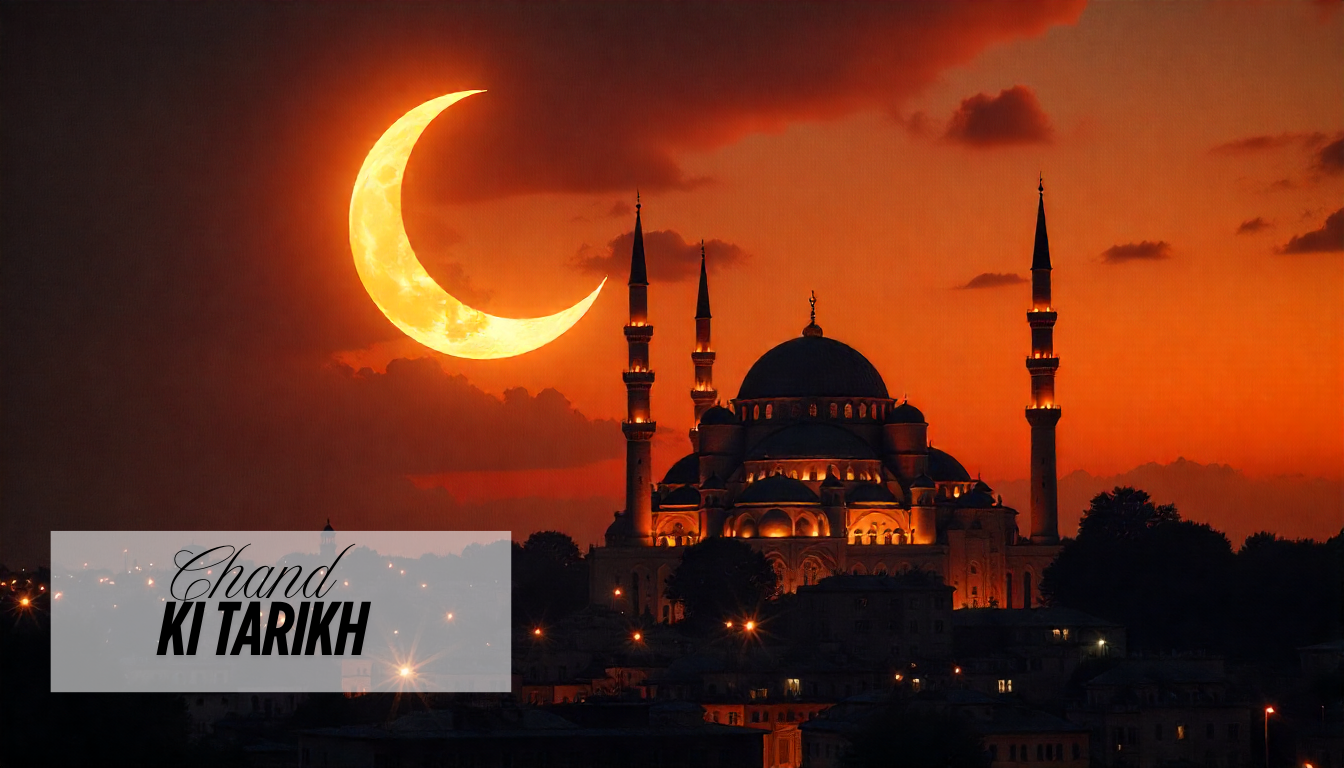
The Islamic calendar, with its lunar system, is very important to the lives of millions of Muslims all over the world. Chand ki tarikh, also known in Urdu as moon date, is the current date of the Islamic calendar based on the Hijri calendar. This pre-Islamic chronology links Muslim societies to their religious roots and gives the context of religious holidays and cultural festivals.
What is Chand ki Tarikh?
Chand ki tarikh is the Islamic date using the lunar calendar system that was invented during the migration of Prophet Muhammad out of Mecca to Medina in 622 CE. This calendar has 12 months of 30 or 29 days respectively producing a year of about 354 -355 days. The calendar is also based on phases of the moon and that is the key reason as to why the word chand in Urdu translates to the moon.
Chand ki tarikh has more than a role in time keeping. It symbolizes a relation to the Islamic tradition and is the basis of the determination of major religious holidays like Ramadan, Eid festivals and Hajj pilgrimage dates. The people of Islam in any part of the world use chand ki tarikh nowadays to keep up with their religious duties and the festival in their community.
Current Islamic Date System
The Chand ki tarikh in the present day differs by one or two days and is determined by local moon sighting. The Islamic date is 9 Rabi al-Awwal 1447 in India, Pakistan and Bangladesh and 11 Rabi al-Awwal 1447 in Arab countries as of September 3, 2025. Such difference arises due to the fact that Islamic dates are traditionally marked by the appearance of the new moon, which could be observed at various times and at various geographical locations.
Islamic chand ki tarikh system is now independent of Gregorian calendar; therefore, the Islamic holidays and events would be celebrated on other dates every year when considered through the solar calendar lens. In this religion-influenced structure, it is seen to ensure that each Islamic month will be repeated in each of the seasons within every 33 years or so to ensure that religious activities are facilitated to get the benefit of different climatic conditions.
The Twelve Islamic Months
There are 12 months of the Islamic calendar with historical and religious meanings. The knowledge that goes into these months will be able to help us get a better understanding of how chand ki tarikh works in the year:
- Muharram – The first month and the holy month.
- Safar – The second month
- Rabi al-Awwal – This is the third month, which is important because Prophet Muhammad was born during this month.
- Rabi al-Thani – Month four.
- Jumada al-Awwal – Fifth month.
- Jumada al-Thani – The 6th month.
- Rajab – The seventh holy month.
- Sha’ban – The eighth month
- Ramadan – Fasting month number 9.
- Shawwal – The tenth month, which has Eid al-Fitr.
- Dhu al-Qadah – Eleventh holy month.
- Dhu al-Hijjah – The twelfth and Hajj and Eid al-Adha in it.
We are in Rabi al-Awwal and this chand ki tarikh is very significant since this month is a month of special blessings and special significance to the Islamic world because it was on the month of Rabi al-Awwal that Prophet Muhammad was born.
Local differences in Islamic Date keeping.
The chand ki tarikh on Islam still sheds a lot of interesting local peculiarities and marks small astronomic observations, local preferences in power faith. South Asian nations such as India, Pakistan and Bangladesh are used to the Islamic date being one to two days behind the dates followed in the Middle East such as Saudi Arabia and the UAE.
This difference is due to the fact that the Islamic dates are normally counted starting with the physical observation of the new moon. The new moon can be seen at different times in different geographical locations depending on the weather conditions, the geographical location and the interpretation of the religious power in the area. Thus, looking up chand ki tarikh today it is important to keep in mind how your particular region observes it.
The system of Islamic calendar used today recognizes such regional variations without compromising the spiritual unity of the world Muslim community. Most of the Islamic organizations and websites work with region specific dates to follow religion properly and align with the community.
The significance of Knowing the Islamic Date in the present day
The knowledge of chand ki tarikh has several practical and spiritual applications in Muslim day to day life. Prayer sessions, fasting, pilgrimage arrangements and other religious duties and responsibilities rely on proper Islamic date information. The Islamic chand ki tarikh is still used today to decide when the key religious events start and finish, and it is therefore essential to be observed correctly.
Spiritually, being in touch with chand ki tarikh helps Muslims remain in touch with Islamic traditions and lunar based patterns of worship that was put in place by Prophet Muhammad. The relationship is more than the keeping of time in a calendar and the relationship is more of an involvement with Islamic spirituality and sense of community.
Contemporary Muslims tend to keep both Gregorian and Islamic calendars running concurrently and consult chand ki tarikh tomorrow in addition to commonplace dates to resolve any extra demands imposed on them by religion with contemporary pressures imposed on them by their lifestyle. The two years on the foundation of the two years in the world system without the eradication of the traditional religious system, the two years system inclusive of the system engulfs the modernity that encloses Islamic practice in the modern post-nowhere of the Islamic world.
Access to the Digital Age and Islamic Calendar
The electronic revolution has revolutionized the way Muslims retrieve chand ki tarikh information. There are plenty of websites, mobile apps and online resources that offer real-time date information in the Islam religion and as a result, chand ki tarikh today is instantly available around the globe. However, such digital tools can also have some extra features like prayer times, Islamic holidays, and calendar displays by month.
Designed websites that only deal with Islamic dates also provide all the details on the present Islamic computing of dates, regional divergencies, and of upcoming important dates. They are used to maintain Islamic community with Muslim events that transpire in the Islamic calendar, regardless of the geographical location of the community or the local astronomical sight clarity.
Digital access to Islamic chand ki tarikh today has facilitated the connection of the global Muslim community to allow the celebration of all religious practices and shared spirituality across various time zones and borders.
Learning Islamic Calendar Knowledge.
This information about chand ki tarikh is of great educational value even outside religious practice. The Islamic calendar system dates back to astronomical computations, cultural history and traditional systems of knowledge existing before modern scientific tools. Knowledge about the way in which Islamic dates are determined by the lunar phases links students to ancient astronomical activities and calculations.
Muslim majority countries generally build Islam calendar studies in their schooling systems, educating them to understand how chand ki tarikh is calculated and why lunar seasons relate to a calendar system. Such knowledge maintains the standard practices of calculating, whilst promoting the value of Islamic intellectual culture.
They also have the opportunity to train comparative calendar analysis and the different ways streams of culture quantify time and socially organize, farm, and experience religion is also compared as a result of the comparison of current Islamic date systems.
Current Uses in the Contemporary Life.
Today Muslims choose to incorporate chand ki tarikh knowledge in most of their modern life experiences by planning business, timekeeping and time planning as well. Islamic banking institutions record their transactions and compute their profits according to Islamic dates and schedule their production activities according to Islamic month cycles and religious principles, the halal food industries.
Today it is common to find wedding planners, event management companies, and travel agencies providing services that cater to Muslim crowds checking the Islamic chand ki tarikh to prevent scheduling conflicts with religious holidays and provide culturally suitable dates on which to conduct a wedding or gathering.
Medical practitioners working with Muslim communities tend to take into account the dates of the Islamic calendar when planning medical operations, knowing that some days of the year have special religious meaning and can determine the preferences of patients and the presence of community support.
The Future of the Islamic Calendar Observance.
Future of the chand ki tarikh practice keeps changing as the world and its Muslims grow more technological. The software used in astronomical calculations now offers much more precisely predicted Islamic dates, but most communities still continue to observe the traditional moon sighting methods in the name of religious authenticity.
Space technology and satellite observations are increasingly being used to determine current Islamic date beginnings, particularly for international Islamic organizations coordinating global Muslim activities. This technological combination preserves the rules of the traditional lunar calendar without compromising on accuracy and synchronization over large geographical locations.
As Muslim population actually rises in other non-Muslim majority nations, chand ki tarikh awareness and notoriety in general calendar systems come into sharp and wholly crucial focus to social accessibility and liberty of faith observation. Learning institutions, employers, and service providers all over the world are coming to appreciate and embrace religious holidays that are based on Islamic calendar.
The maintenance and popularization of the knowledge of the Islamic calendar guarantee that future generations of Muslims retain their relation to this form of Islamic identity and are able to effectively negotiate the new multicultural societies.
Frequently Asked Questions
What is Chand ki tarikh and how is it determined in the Islamic calendar?
Chand ki tarikh The Islamic date as calculated using the lunar calendar. It depends on the new moon being seen which is used to mark the start of every month of the Islamic calendar.
Is Chand ki tarikh the same worldwide each day?
No, chand ki tarikh may differ by region since it is the moon crescent that will be seen at different times based on local geography and weather. Islamic months may be starting on a slightly different day across different countries.
How many months are Islamic (Hijri)?
The Islamic calendar has 12 months. These months depend on the moon phases, and are 354 or 355 days in a year.
What is the reason why the Islamic calendar year contains fewer days as compared to Gregorian calendar?
The Islamic calendar is lunar with months of 29 and 30 days which makes the year about 11 days shorter than Gregorian 365/366 day calendar.
What are some of the main months and events recognized by Chand ki tarikh?
The most important in the form of months and days are Ramadan (month of fasting), Shawwal (Eid al-Fitr), Dhul-Hijjah (Hajj and Eid al-Adha) and Rabi al-Awwal (month of birth of Prophet Muhammad). Such observances are marked by key dates in chand ki tarikh.
How can I check Chand ki tarikh today and the current Islamic date?
Today you can lookup the current chand ki tarikh in reliable Islamic websites, applications, or community announcements and they will tell you the Islamic date of the day depending on your location.
Why is moon sighting so important in determining chand ki tarikh?
Each of these Islamic months begins when the new moon is seen after the precedent which was observed during the era of Prophet Muhammad. This keeps the religious events in check according to the right timing.
What does it mean when Chand ki tarikh changes at sunset?
The Islamic day begins at sunset, so chand ki tarikh changes at that time rather than at midnight like the Gregorian calendar. It implies that the Islamic date moves forward of Maghrib prayer.
Do Chand ki tarikh have mobile apps or digital tools?
Yes there are lots of mobile applications and websites that show chand ki tarikh of the day and the current Islamic date and the prayer time, thus it is easy to keep up to date anywhere.
So what is the use of knowing chand ki tarikh in the life of a Muslim?
Prayers, fasting, holidays, and religious obligations depend heavily on chand ki tarikh to help Muslims observe key events based on the proper Islamic calendar dates.
Conclusion
Chand ki tarikh is also not merely a second history of keeping time, but the spiritual cycles of Islamic life, and the connection of Muslim communities to their own history and to the responsibilities of their faith, everywhere on the planet. On the one hand, it also improves the spiritual practice and cultural awareness in that within this lunar working calendar, you are checking the chand ki tarikh today to pray each day or you are scheduling some religious holidays or you are checking at several other places just keeping up with the Islamic practices.
Islamic chand ki tarikh even today still remains a guide to millions of Muslims in the area by directing them in their religion, social planning, and spiritual growth. The Islamic calendar is a well-timed path between the old and the new world as we advance through the contemporary world, and the ancient wisdom, at the same time, helps preserve the divine oracle of lunar years and months so that the divine thread of Islamic way of life will guide the further generations.
By staying informed about current Islamic date and understanding its significance, Muslims maintain their connection to a timekeeping system that has guided Islamic civilization for over 1400 years, while adapting its application to meet the needs of our ever-changing world.